
Small
Friday November 14, 2025


Warning: This is a long one.
I’ve gotten a crazy bee under my bonnet recently. As you all know, I have a remarkable tendency to not let the bees that get under my bonnet stay in there until they wither and die, but seldomly, one stings me so friggin’ hard I can’t let it go:
Working in Hollywood.
Moving back to Boston with the girl I’d been dating for 9 months.
Quitting my job to freelance full-time.
Starting a business to lower my tax liability.
Going back to the corporate world to get paternity leave.
Writing this newsletter every week.
Well, now I’ve housed one of the biggest motherfucking bees of my life. I am slowly becoming obsessed with the idea of buying a business.
I’m admittedly a little bit late to the acquisition entrepreneurship trend, but not so late that the market’s overinflated. I think a lot of people assume that business acquisition is something that private equity firms and tech giants do, but it’s much more accessible for individuals than you might think.
The U.S. Small Business Administration guarantees 75% of 7(a) loans over $150,000, which is a major reason why the default rate is just 3.7%. (I’m not linking to any of Chairman Mao’s propaganda-riddled government websites.) These loans require only a 10% equity injection (down payment), half of which may be offset by seller financing. There are closing costs and working capital considerations, so it’s not like you can buy a $1 million business for $50,000, but it’s not not like that either.
When you think of the alternative — starting a business — it almost doesn’t make sense why anybody would build from scratch. There were nearly 35 million small businesses in the U.S. as of July 2024, and just 4% of them earn more than $1 million per year. Almost half of all businesses fail within their first five years. The number of small businesses grows every year despite this astronomical failure rate because everybody thinks they have a million-dollar idea. But, as shouldn’t be remotely surprising in late-stage Capitalism, the best way to get a million-dollar idea is to buy it.
80% of high-net-worth people own businesses. I’d wager more than half of them didn’t actually start anything themselves; they just bought companies that were already working. We’re in the midst of the greatest wealth transfer in history, and there are hundreds of thousands of retiring small business owners who are selling their hard-earned cash flows to retail buyers. Private equity doesn’t care about businesses making less than $5 million a year. I do.
I’ve always been sort of entrepreneurial. I started a landscaping business in high school, got my neighbors to hire me, and quickly lost all the business because I hired friends who were so embarrassingly lazy that my next-door neighbor literally fired us. I did a couple of jobs on my own to make a few bucks before college, but Grass Guys died as ignominiously as its name.
In college, I did the painting labor scam thing with Collegiate Entrepreneurs, but actually made okay money because I was better enough at painting than cold calling to earn a reasonable hourly wage. (You were paid by sections completed within a designated timeframe. You were not paid to cold call, just required to do it.)
Hell, I’m a small business owner right now, doing better than average. I don’t really think of it as a small business, but Flocked Creative is a registered LLC with the state of Massachusetts, so it can’t be denied.
But I’m seeing the ceiling again. Or, rather, I’m feeling my interest in even finding the ceiling wane. What do I really want to do for the rest of my one life? Churn out copy about financial services and small businesses? I could probably take on a couple more clients. I could outsource some work to freelancers or find a partner to offer more services. There may be a promotion or two in my future at iQuanti. There is room for growth. But, like, what am I going to be doing in my 50s? I’m not exactly on Chief Marketing Officer track. Realistically, my ceiling is Editorial Director, which is fine, but doesn’t excite me all that much. I didn’t realize it at the time, but when I quit my management job at StackCommerce to leverage my one elite skill, I put a lot of eggs in the labor basket. I then grew fat from the fruits of my labor, which made the path to leadership exceedingly tight. To get rich, you must command the labor of others, and I so zealously protected the value of my own that I lost sight of this fact. What a hilarious irony for a socialist.
To be clear, I don’t want to buy a business to become rich. I want to buy a business to do something interesting. I wouldn’t say I’m bored yet, but I can see the horizon. And, like, yeah, passive income is anybody’s dream.
All I know about running companies is what I’ve read, but solving problems, identifying opportunities, and providing services that make a difference in people’s lives… yeah, that excites me. Betting big on myself to turn a good opportunity into a great one excites me. The limitless potential of buying and building excites me. Running just about any small business sounds more captivating than whatever career I’m leading now.
Like I said, it’s not as far-fetched as you might think. I’m not ready to do this yet, either financially or personally. Lindsay would divorce me if I quit my job and dumped my life savings into a business right now.
But let’s do number fun based on a real listing that I watched go into pending this week:
Business sale price: $595,000
Gross revenue: $924,000
SDE (Seller’s Discretionary Earnings — basically the cash flow the owner can use to service debt, reinvest, or pay themselves): $359,000
For these purposes, let’s pretend we want to borrow an additional $100,000 to use as working capital for the business. Toss in another $30,000 or so for closing costs and legal fees, and we’re looking at a total borrowed amount of $725,000.
The SBA requires only a 10% equity injection, which in this case is $72,500.
At a 10-year term and 10% interest, a $652,500 loan will cost about $8,623/month.
This business is currently cash flowing nearly $30,000/month. Even after the $8,623 debt service coverage and, say, $5,000 for reinvestment and contingency planning, you’re left with more than $16,000/month in earnings. You also borrowed an additional $100,000 that can serve as a buffer for any temporary cash flow dips. With a good team in place to continue running the business as usual, you could do practically nothing and earn $192,000/year.
Obviously, it’s not that simple. This deal has such a low SDE multiple (business price/SDE) that it raises questions. There’s a learning curve to running any business. The seller might hide something from you that you miss in your own due diligence. You still have to show up and convince everyone to keep working for you. (Not guaranteed, as my dad can tell you after he and his girlfriend, Amy, got screwed when they bought a screen printing business by the key employee reneging on his promise to stay on. Vermont's labor market isn’t exactly swimming in skilled or unskilled labor, so Dad and Amy have been stuck doing most of the physical work. They’re still profitable, but it’s work!)
The process is also exceedingly difficult to navigate. Private equity, private investors, and acquisition entrepreneurs flood the market, making good deals exceedingly hard to find or compete for. There are thousands of “buy-curious” people like me who business brokers don’t take seriously. But you need to be at the top of their minds because the vast majority of deals that hit the listing sites only made it that far because reputable, experienced buyers passed on them. That’s not to say you can’t find anything intriguing, but then you’re competing with the aforementioned thousands scrambling to buy their first business, whom brokers basically lump all together as a waste of time.
That particular issue is why I’m seriously considering applying for an accelerator. You’re going to start seeing a million social media ads from SMB Deal Hunter, Acquisition Lab, Acquira, Franchise Sidekick, and the like after reading this post, so sorry about that. Of course, like anything that supersaturates the social media ad space, I have a healthy dose of skepticism about these things. But I’ve gone through several marketing funnels and, got to say, they’re pretty damn convincing, especially when paired with the testimony I’ve read on Reddit and heard on podcasts about how friggin’ hard it is to be taken seriously without $500k+ in liquidity. Accelerators aren’t cheap, but they reduce the competition, cut down on search time, provide due diligence support, and, most importantly, represent you in the marketplace so that brokers know you’re serious. I don’t know, in the next year or so, I might feel okay spending the $10,000 or so to join one.
My imagination is running, at least, which is fun. I’m excited about a theoretical future and motivated to make it a reality, if it’s possible. And I’m serious enough that I’m not going to tell you a thing about my acquisition strategy.
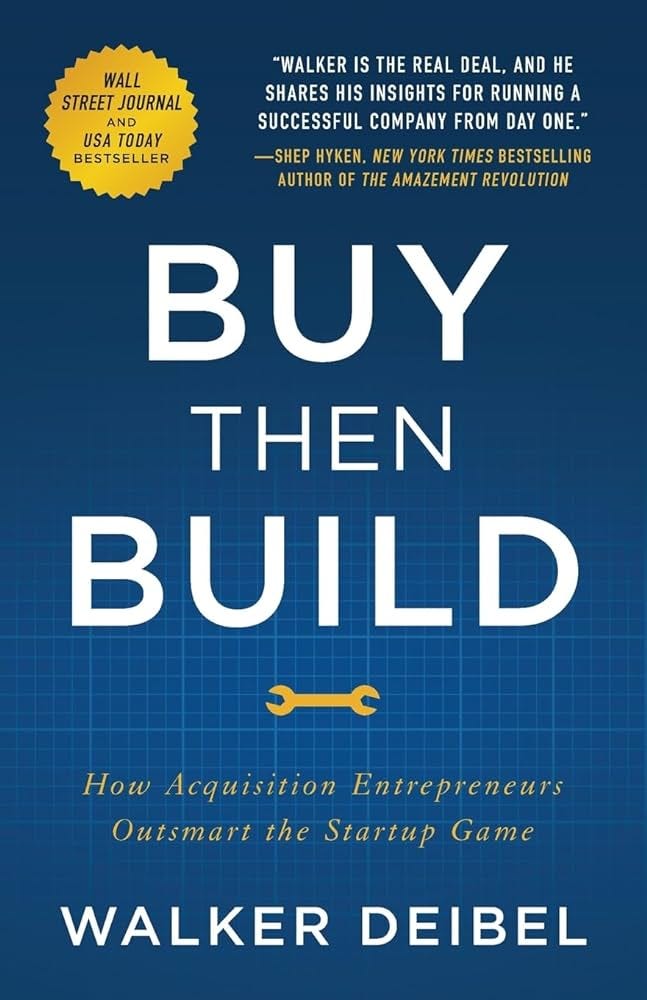
One Book: Buy Then Build by Walker Deibel
The New Testament of Acquisition Entrepreneurship to Richard Ruback and Royce Yudkoff’s Old Testament, HBR Guide to Buying a Small Business, Buy Then Build has inspired thousands since 2018 to do what I’m talking about right now. Deibel is far more pragmatic than many of the Instagram snakes pitching absentee businesses and buy-cash-flowing-companies-for-$0-down schemes, despite the fact that he very likely helped create them in the first place. Deibel is a serial entrepreneur who made his money building and selling companies before realizing exactly what I regurgitated to you here: Buying established businesses eliminates a huge amount of the risk of entrepreneurship and is shockingly more attainable than you might think. His book reads very much like a tech bro’s guide to molding oneself for opportunity, but it’s full of interesting statistics and useful guidance to help you figure out if running someone else’s business is actually something you want to do. Because, as he says, it’s not something you set and forget — it only makes sense if you bring something that the business was lacking.
One Hollywood: We Bought a Zoo
Dammit, you caught me. I’m just trying to buy a zoo.